Why Annual Maintenance Pays for Itself
Your garage door is the largest moving part of your home. It cycles up and down thousands of times a year, exposed to Charlotte's humid summers, occasional ice storms, and everything in between. Like your HVAC system or your car, it needs regular attention to perform reliably and safely — and skipping that attention has real costs: premature spring failure, burned-out openers, damaged cables, and doors that fall off their tracks at the worst possible moment.
The good news is that most maintenance tasks are simple, and catching a $50 problem before it becomes a $400 repair is one of the most satisfying wins a homeowner can get. This guide walks through what you can handle yourself and what should always involve a professional.
The Annual Maintenance Checklist: What You Can Do Yourself
1. Listen and Watch the Door in Motion
The easiest maintenance step costs nothing: pay attention. Run the door through a full open-and-close cycle and observe carefully. You're listening for grinding, scraping, or popping sounds and watching for jerky movement, uneven travel, or the door pausing mid-cycle. Any of these symptoms indicate something worth investigating further. If the door sounds different than it did six months ago, that change means something.
2. Visually Inspect Springs, Cables, and Hardware
With the door closed, look at the torsion spring above the door opening. It should be one continuous, tightly wound coil with no visible gap. Check the lift cables running from the bottom corners of the door up to the cable drums — look for fraying, rust, or any unwinding from the drum. Inspect the hinges and brackets along the door sections for cracks, rust, or loose bolts.
Do not touch or attempt to adjust springs or cables yourself. These components are under extreme tension and require professional tools and training. If you see a gap in the spring coil or a frayed cable, stop using the door and call our team. Our spring replacement service and cable repair service handle these situations safely.
3. Tighten Loose Hardware
A garage door that runs thousands of cycles a year vibrates constantly. Over time, the bolts holding the track brackets, hinges, and roller brackets to the door and wall gradually loosen. Use a socket wrench to snug up any hardware that moves when you try to wiggle it. Don't overtighten — just firm enough that there's no play.
4. Test the Door's Balance
Disconnect your opener by pulling the red emergency release cord. Lift the door manually to about waist height and let go. The door should stay in place — or drift only slightly. If it falls quickly or rises on its own, the springs are out of balance. An unbalanced door puts undue stress on every other component in the system. This is a job for a technician, not a homeowner.
5. Test the Auto-Reverse Safety Features
Your opener should have two safety mechanisms: an infrared sensor that stops and reverses the door if something breaks the beam near the floor, and a pressure-reversal system that reverses the door if it contacts an object while closing. Test both:
- Sensor test: While closing the door, wave a broom handle through the sensor beam near the floor. The door should immediately reverse.
- Pressure test: Place a 2x4 flat on the ground under the door and close it. The door should reverse when it contacts the board.
If either test fails, stop using the opener and call for service. Auto-reverse failure is a serious safety hazard, especially for families with children or pets.
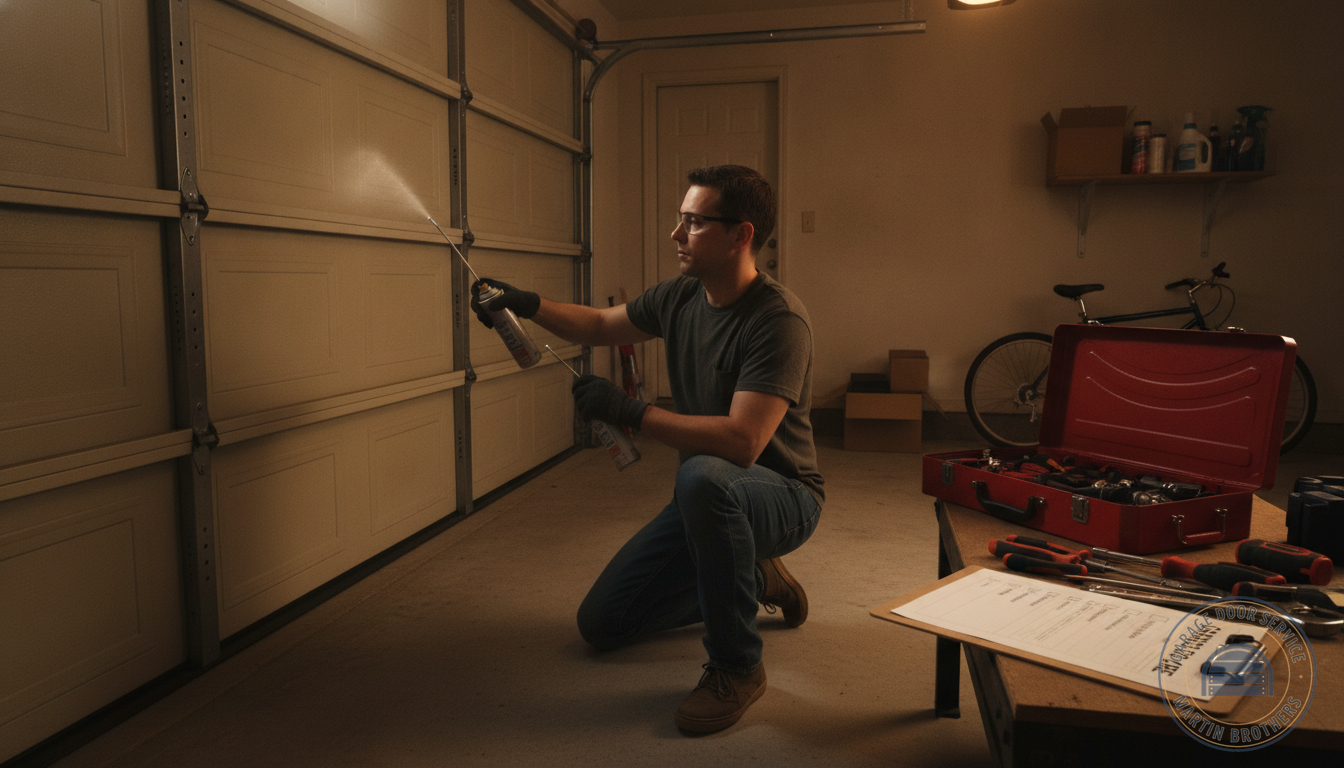
6. Lubricate All Metal Moving Parts
Use a product specifically designed for garage doors — not WD-40, which is a cleaner and degreaser, not a lubricant. Apply a thin coat of white lithium grease or dedicated garage door lubricant to:
- The torsion spring (not extension springs — they don't need lubrication)
- All roller stems (avoid plastic rollers)
- Hinges at each pivot point
- The top of the rail where the trolley carriage travels (for chain and screw drives)
- The lock mechanism if your door has one
Do not lubricate the tracks themselves — the rollers need to grip the track, not slide on it.
7. Inspect and Replace Weatherstripping
The rubber seal along the bottom of your door takes a beating from sunlight, temperature swings, and vehicle exhaust. Check for cracking, gaps, or sections that have pulled away from the door. A compromised bottom seal lets in rainwater, pests, and conditioned air — a real concern during Charlotte's warm, humid summers. Side and top weatherstripping around the door frame should also be checked for gaps that let in drafts.
What Should Always Be Left to Professionals
While the steps above are safe for most homeowners, certain garage door work carries serious injury risk and should always involve a trained technician:
- Spring replacement or adjustment — Torsion springs store enormous energy. Mishandling them causes severe injuries every year.
- Cable replacement or reattachment — Like springs, cables are under tension and can whip violently if they slip.
- Track realignment — Misaligned tracks can cause the door to jam or fall off entirely if corrections are made incorrectly.
- Opener force and travel-limit adjustments — Incorrect settings can cause the door to crush objects (or people) without reversing.
Our professional tune-up and safety inspection service covers all of these items in a single visit — including lubrication, hardware tightening, balance testing, spring and cable inspection, auto-reverse verification, and opener calibration. It's the most efficient way to make sure your entire system is operating within safe parameters.
How Often Should Charlotte Homeowners Schedule Professional Maintenance?
Once a year is the standard recommendation. If your garage door sees four or more cycles per day — common in busy Charlotte households — twice yearly service is worth considering. After any significant event (a vehicle impact, storm damage, power surge, or a spring or cable failure), a post-repair inspection is also smart to confirm nothing else was affected.
We serve homeowners throughout Charlotte and its neighborhoods, including Dilworth, Plaza Midwood, Myers Park, SouthPark, Coulwood, and University City. Whether your garage has a single-car door on a craftsman bungalow or a three-car setup on a newer construction home, the maintenance principles are the same.
Schedule Your Annual Tune-Up with Garage Door Service Martin Brothers
Don't wait for something to break. A proactive tune-up is almost always faster, cheaper, and less disruptive than an emergency repair call. Garage Door Service Martin Brothers is available Monday through Sunday, 8:00 AM to 6:00 PM, across Charlotte, NC.
Call us at +1 (980) 480-4187 to schedule your inspection, or visit our tune-up and safety inspection page to learn exactly what our technicians check on every visit. And if your maintenance inspection reveals a panel issue, opener problem, or worn springs, we can often address those repairs the same day — see our full list of services including panel replacement and opener repair and installation.
Need Service?
Call +19804804187 or fill out our online form for a free, no-obligation quote.
Request Free Quote